
by MH Team | Oct 18, 2023 | Transfusion Medicine
Key Takeaways An acute hemolytic transfusion reaction (AHTR) is the rapid destruction of transfused red blood cells, occurring during or within 24 hours of a blood transfusion, and it is a medical emergency [1][3]. Timing ▾: During transfusion or within 24...
by MH Team | Oct 17, 2023 | White Blood Cells
Key Takeaways Multiple myeloma is a cancer of plasma cells, a type of white blood cell that produces antibodies. In this condition, abnormal plasma cells multiply uncontrollably and accumulate in the bone marrow. It is slightly more common in males than females and...
by MH Team | Oct 17, 2023 | Platelet Disorders
Key Takeaways Hemophilia is an inherited disorder of secondary hemostasis caused by a deficiency of factor VIII (hemophilia A) or factor IX (hemophilia B); both result in delayed, deep tissue bleeding rather than immediate surface bleeding. Clinical features ▾:...
by MH Team | Oct 16, 2023 | Platelet Disorders
Key Takeaways Vitamin K deficiency bleeding (VKDB) is a preventable disorder in newborns and infants caused by low active levels of clotting factors II, VII, IX, and X. Causes: All newborns are physiologically vitamin K deficient at birth because of poor placental...
by MH Team | Oct 16, 2023 | Platelet Disorders
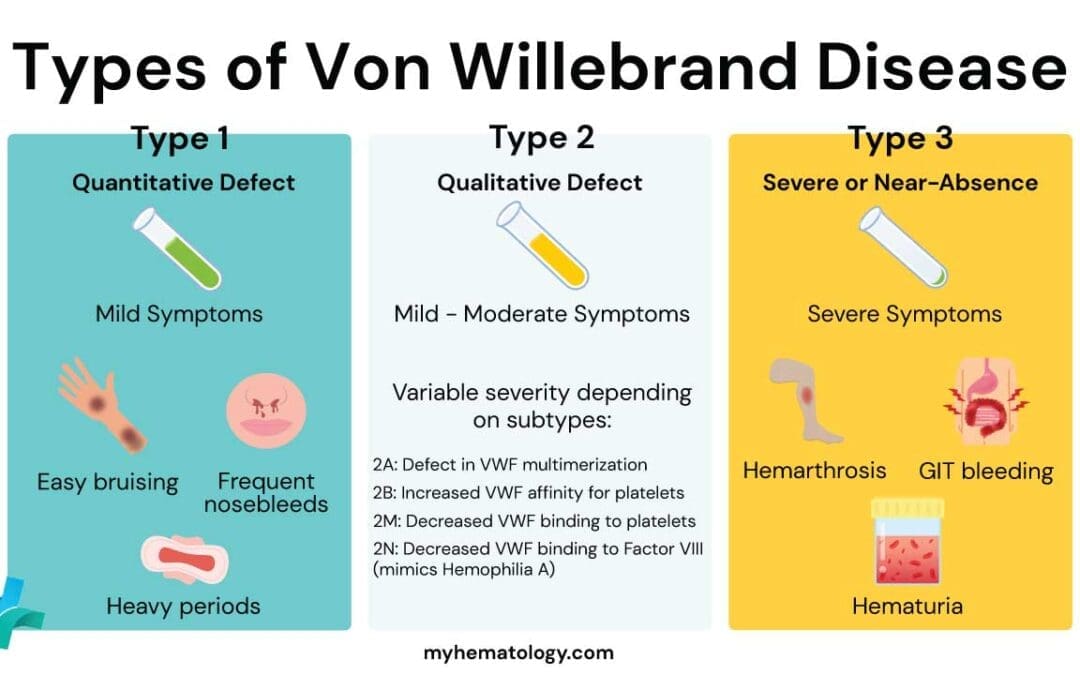
Key Takeaways Von Willebrand disorder, also called von Willebrand disease (VWD), is the most common inherited bleeding disorder, affecting roughly 1 in 1,000 people, and is caused by a missing or defective protein called von Willebrand factor that normally helps...



Recent Comments