Key Takeaways
CMML (chronic myelomonocytic leukemia) is a blood cancer that starts in one faulty bone marrow stem cell and causes the body to overproduce monocytes, a type of white blood cell. It sits between two disease families: myelodysplastic syndromes and myeloproliferative neoplasms [1].
- Subtypes ▾: The disease is split into MD-CMML (white cell count below 13 × 10⁹/L) and MP-CMML (count of 13 × 10⁹/L or higher), and the type guides treatment [1].
- Causes ▾: The three most common mutations are TET2, SRSF2, and ASXL1. Truncating ASXL1 mutations reliably predict shorter survival [1].
- Diagnosis ▾: Requires a sustained monocyte count of at least 0.5 × 10⁹/L (with monocytes making up 10% or more of white cells), plus proof of a clonal genetic change [2,3].
- Treatment and management ▾: Hypomethylating agents and stem cell transplant remain the main treatments, and newer trials are testing mutation-matched precision therapies [1,5].
*Click ▾ for more information
Why CMML Matters
CMML is one of the more puzzling blood cancers, and that is exactly why it is worth understanding. It blends two opposite behaviors in a single disease, which makes it hard to classify and hard to treat.
CMML is a clonal hematopoietic stem cell disorder. That means it begins when one blood-forming stem cell acquires a genetic change and then copies itself, so all the faulty cells share the same mutation. CMML is uncommon, with an estimated 0.63 to 1.0 cases per 100,000 people each year [1]. It is largely a disease of older adults. The median age at diagnosis is about 73 to 75 years, and men are affected more often, by roughly 1.5 to 3 to 1 [1]. As populations age, clinics are seeing it more often.
Clinical Manifestations
What Makes CMML Unique: An Overlap Disease
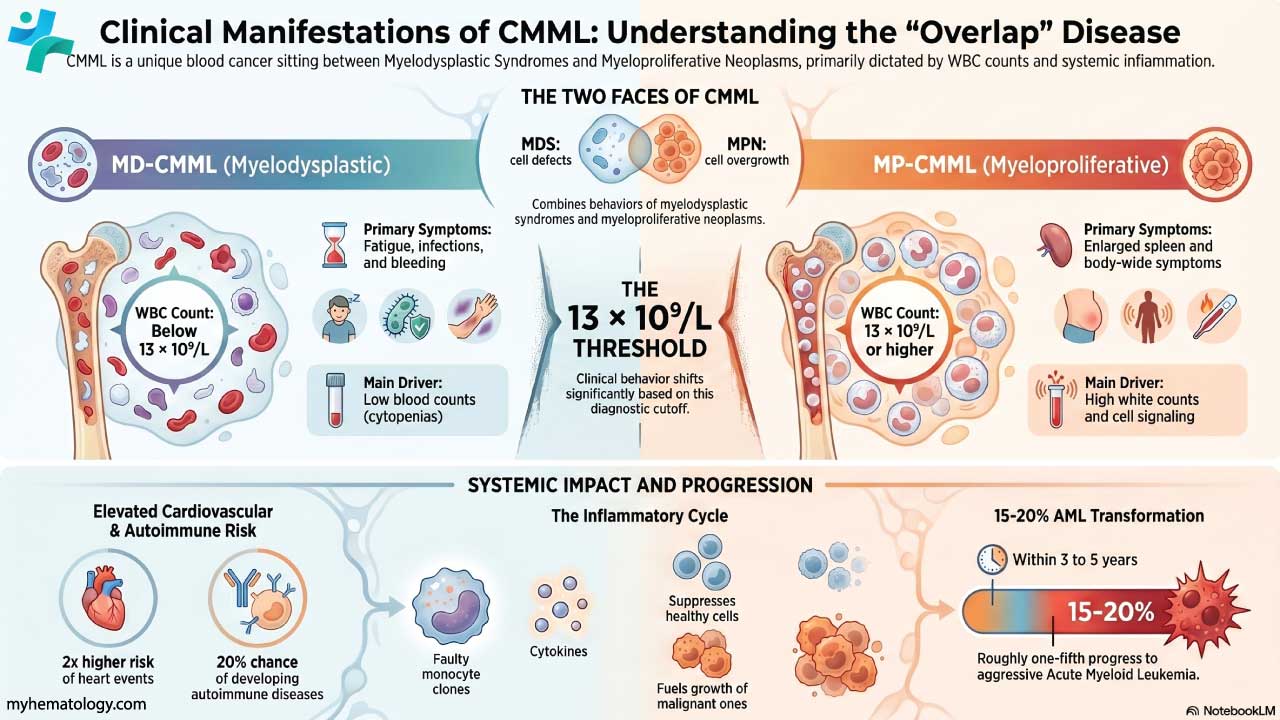
To understand CMML, look at how it behaves in the bone marrow and blood. Acute leukemias stop blood cells from maturing. CMML does something different. It shows both dysplasia, meaning cells form abnormally (the hallmark of myelodysplastic syndromes), and proliferation, meaning the body makes too many mature cells (the hallmark of myeloproliferative neoplasms) [1].
This dual nature explains the clinical presentation. The disease is split into two faces based on white blood cell count, which shapes how the disease behaves:
- MD-CMML (myelodysplastic): White cell count below 13 × 10⁹/L. Patients typically present with low blood counts, fatigue, infections, and bleeding [1].
- MP-CMML (myeloproliferative): White cell count of 13 × 10⁹/L or higher. Patients typically present with an enlarged spleen, body-wide symptoms, and high white counts [1].
Beyond the Blood: Inflammation, Heart Risk, and Transformation
CMML is not confined to the marrow. Overproduced abnormal monocytes have effects throughout the body. Patients face about a two-fold higher risk of cardiovascular events than peers of the same age, and roughly 20% develop an autoimmune disease [1].
These effects come from a cycle that fuels itself: faulty monocyte clones pour pro-inflammatory cytokines into the marrow, suppressing healthy stem cells. The mutant CMML cells thrive in high inflammation, driving their own growth while straining the heart and immune system.
The biggest danger in CMML is transformation into acute myeloid leukemia (AML). About 15% to 20% of patients transform within three to five years [1]. AML that arises this way resists standard chemotherapy, so doctors monitor closely for rising blast cells.
Laboratory Investigations and Diagnosis
Diagnostic Thresholds and "Oligomonocytic" CMML
The rules for diagnosing CMML changed significantly in 2022. Lowering the monocyte threshold captures early disease known as "oligomonocytic" CMML (OM-CMML). Diagnosis requires a monocyte count of 0.5 × 10⁹/L or higher, as long as monocytes make up at least 10% of the white cell differential [2,3]. Because a lower count could appear in harmless, reaction-driven monocytosis, the rules require proof of a clonal genetic change [3].
Predicting OM-CMML Progression
In 2026, clinical practice utilizes a landmark genomic model to predict which OM-CMML cases will progress to overt CMML versus those that will behave like standard myelodysplastic syndrome. The model assigns points: an ASXL1 mutation (+4 points), biallelic TET2 alterations (+3), and bone marrow monocytosis of 7% or greater (+2). A score of 4 or higher reliably predicts rapid progression, guiding earlier access to CMML-specific therapies [9].
Flow Cytometry
Flow cytometry adds a supportive diagnostic clue. Healthy blood has a mix of monocyte types, but in CMML the "classical" monocytes (marked CD14+ and CD16−) expand sharply. When classical monocytes make up more than 94% of all monocytes, that strongly points to CMML with >90% sensitivity and specificity [1].
The Molecular Engine: Genetics
Genetics sits at the center of modern CMML diagnosis. More than 90% of patients carry somatic (acquired) mutations affecting epigenetic regulators and the spliceosome. Three mutations dominate [1]:
- TET2: Appears in ~60% of patients.
- SRSF2: Appears in ~50% of patients.
- ASXL1: Appears in ~40% of patients. Truncating ASXL1 mutations reliably predict shorter overall survival and immediately raise a patient's risk category.
CMML progenitor cells are also unusually sensitive to GM-CSF, a growth factor that drives monocyte production. This is a vulnerability targeted by newer therapies [5].
Predicting the Course: 2026 Risk Models
Because CMML varies so much between patients, prognostic models are essential. While tools like the Mayo Molecular Model (MMM) and CPSS-Mol were used historically, standard care in 2026 relies on the International CMML Prognostic Scoring System (iCPSS) [7].
The iCPSS defines biologically distinct entities based on molecular taxonomy. It accurately identifies transplant-eligible patients at earlier disease stages, optimizes the timing of stem cell transplants, and improves the prediction of post-transplant relapse risks. Additionally, the newly proposed Objective Prognostic Index for CMML (OPIC) utilizes easily accessible complete blood count (CBC) variables, such as the monocyte-to-lymphocyte ratio, to aid in risk stratification [8].
Treatment and Management
Standard Therapies: Why One Drug Is Often Not Enough
For years, hypomethylating agents (HMAs) such as azacitidine, decitabine, and the oral combination of decitabine and cedazuridine have been the standard for higher-risk patients [1,6]. While these drugs produce useful responses, they rarely clear the disease completely and do not cure the underlying cancer. Most patients eventually relapse or progress, pushing the field toward combination therapies.
The Only Possible Cure: Stem Cell Transplant
An allogeneic stem cell transplant (HSCT) is the only treatment that can cure CMML, but it carries serious risks. Because most patients are older and have other health conditions, only about 10% are eligible [1]. For those who are, timing is a balancing act optimized by the iCPSS, weighing the immediate risks of transplant against the longer-term risk of transformation to AML.
Emerging and Targeted Treatments
CMML care is defined by personalized, mutation-matched precision therapies and novel targeted agents:
STX-0712: Receiving FDA fast-track designation in mid-2026, STX-0712 is a highly targeted small molecule attached to a cell-killing antibody. It specifically targets CCR2, a protein heavily expressed on the surface of cancerous CMML monocytes. By directly depleting malignant monocytes and the bone marrow cells that drive the disease, it offers a powerful precision approach for relapsed or refractory CMML [10].
Lenzilumab and the PREACH-M Trial: Patients with RAS-pathway mutations (NRAS, KRAS, or CBL) receive azacitidine combined with lenzilumab, an antibody that blocks GM-CSF to dampen the monocyte overdrive. Patients with TET2 mutations but no RAS mutation receive azacitidine with high-dose vitamin C (sodium ascorbate). Recent 2026 follow-ups confirm highly durable, long-term responses and clinical improvements in high-risk proliferative CMML patients [5].
Frequently Asked Questions (FAQs)
What is CMML in simple terms?
CMML, or chronic myelomonocytic leukemia, is a blood and bone marrow cancer. It begins in a single faulty stem cell and causes the body to make too many monocytes, a type of white blood cell. It shares features of two disease families: myelodysplastic syndromes (abnormal-looking cells) and myeloproliferative neoplasms (too many cells). It mostly affects people over 70.
How is CMML diagnosed?
Doctors look for a sustained rise in blood monocytes lasting more than three months, with monocytes making up at least 10% of white blood cells. Since 2022, the threshold dropped to an absolute monocyte count of 0.5 × 10⁹/L or higher, but only when a clonal (cancer-related) genetic change and bone marrow abnormalities are confirmed. A bone marrow biopsy and genetic testing complete the picture. Flow cytometry showing more than about 94% "classical" monocytes also supports the diagnosis.
Is CMML curable?
For most patients, no. An allogeneic stem cell transplant is the only treatment that can cure CMML, but only about 10% of patients are eligible because of older age and other health conditions. Most patients are managed to control symptoms and slow progression rather than cured.
What is the difference between MD-CMML and MP-CMML?
The split is based on the white blood cell count. MD-CMML (myelodysplastic type) has a count below 13 × 10⁹/L and tends to cause low blood counts, fatigue, and infections. MP-CMML (myeloproliferative type) has a count of 13 × 10⁹/L or higher and tends to cause an enlarged spleen and other body-wide symptoms. The type guides treatment.
Can CMML turn into another cancer?
Yes. Roughly 15% to 20% of patients progress to acute myeloid leukemia (AML) within three to five years. AML that develops this way is hard to treat, so doctors watch closely for rising "blast" cells to catch the change early.
Are there new treatments for CMML?
Research is moving toward precision medicine that targets specific mutations. The PREACH-M trial pairs azacitidine with lenzilumab (an anti-GM-CSF antibody) for patients with RAS-pathway mutations, and azacitidine with high-dose vitamin C (ascorbate) for those with TET2 mutations. Early results have been promising but are still preliminary.
Glossary of Related Medical Terms
- Clonal hematopoietic stem cell disorder: A blood cancer that starts when one abnormal blood-forming stem cell copies itself, so all the faulty cells share the same genetic change (a "clone").
- Monocyte: A type of white blood cell that fights infection and clears debris. CMML overproduces them.
- Monocytosis: A higher-than-normal number of monocytes in the blood.
- Dysplasia: Abnormal cell shape and development. A blood cell that looks or matures the wrong way.
- Cytopenia: A low count of one or more blood cell types (red cells, white cells, or platelets).
- Splenomegaly: An enlarged spleen, which can cause belly fullness and low blood counts.
- Spliceosome: The cell machinery that edits RNA messages. Mutations in its parts (like SRSF2) scramble gene instructions.
- Epigenetic regulator: A protein that controls which genes are switched on or off without changing the DNA code itself (TET2 and ASXL1 are examples).
- Hypomethylating agent (HMA): A drug, such as azacitidine or decitabine, that loosens the "off switches" on genes to help cells mature more normally.
- Allogeneic stem cell transplant: Replacing a patient's diseased marrow with healthy blood-forming cells from a donor. The only potential cure for CMML.
- Leukemic transformation: When CMML progresses into acute myeloid leukemia (AML), a faster and more dangerous cancer.
- GM-CSF: A signaling molecule (growth factor) that tells the body to make more monocytes. CMML cells are unusually sensitive to it.
Disclaimer: This article is intended for educational and informational purposes only. It is not intended to be a substitute for informed professional medical advice, diagnosis, or treatment. While the information presented here is derived from credible medical sources and is believed to be accurate and up-to-date, it is not guaranteed to be complete or error-free. See additional information.
References
- Patnaik, M. M., & Tefferi, A. (2024). Chronic myelomonocytic leukemia: 2024 update on diagnosis, risk stratification and management. American journal of hematology, 99(6), 1142–1165. https://doi.org/10.1002/ajh.27271
- Baumgartner, F., Baer, C., Bamopoulos, S., Ayoub, E., Truger, M., Meggendorfer, M., Lenk, M., Hoermann, G., Hutter, S., Müller, H., Walter, W., Müller, M. L., Nadarajah, N., Blombery, P., Keller, U., Kern, W., Haferlach, C., & Haferlach, T. (2024). Comparing malignant monocytosis across the updated WHO and ICC classifications of 2022. Blood, 143(12), 1139–1156. https://doi.org/10.1182/blood.2023021199
- Malcovati L. (2024). Navigating the misty lands of monocytosis. Blood, 143(12), 1062–1064. https://doi.org/10.1182/blood.2023023332
- Arber, D. A., Orazi, A., Hasserjian, R. P., Borowitz, M. J., Calvo, K. R., Kvasnicka, H. M., Wang, S. A., Bagg, A., Barbui, T., Branford, S., Bueso-Ramos, C. E., Cortes, J. E., Dal Cin, P., DiNardo, C. D., Dombret, H., Duncavage, E. J., Ebert, B. L., Estey, E. H., Facchetti, F., Foucar, K., … Tefferi, A. (2022). International Consensus Classification of Myeloid Neoplasms and Acute Leukemias: integrating morphologic, clinical, and genomic data. Blood, 140(11), 1200–1228. https://doi.org/10.1182/blood.2022015850
- Thomas, D., et al. (2026). Durable Responses to Lenzilumab: Azacitidine Combination Therapy in High Risk Proliferative Chronic Myelomonocytic Leukaemia with Suppression of CBL and RAS Mutant Subclones. 2025 EHA Abstract.
- Itzykson, R., Santini, V., Thepot, S., Ades, L., Chaffaut, C., Giagounidis, A., Morabito, M., Droin, N., Lübbert, M., Sapena, R., Nimubona, S., Goasguen, J., Wattel, E., Zini, G., Torregrosa Diaz, J. M., Germing, U., Pelizzari, A. M., Park, S., Jaekel, N., Metzgeroth, G., … Fenaux, P. (2023). Decitabine Versus Hydroxyurea for Advanced Proliferative Chronic Myelomonocytic Leukemia: Results of a Randomized Phase III Trial Within the EMSCO Network. Journal of clinical oncology : official journal of the American Society of Clinical Oncology, 41(10), 1888–1897. https://doi.org/10.1200/JCO.22.00437
- Lanino, L., Hunter, A. M., Gagelmann, N., Robin, M., Dall'Olio, D., Flamigni, A., Sala, C., Gurnari, C., Wang, Y. H., Pleyer, L., Xicoy, B., Montalban-Bravo, G., Shih, L. Y., Alsugair, A., Fathima, S., Gregorio, C., Rollo, C., Palomo, L., Platzbecker, A. S., Asti, G., … iCPSS Alliance (2026). Molecular-Based Ecosystem to Improve Personalized Medicine in Chronic Myelomonocytic Leukemia. Journal of clinical oncology : official journal of the American Society of Clinical Oncology, JCO2502116. Advance online publication. https://doi.org/10.1200/JCO-25-02116
- Calvo, X., Rial-Villavecchia, A., Roman-Bravo, D., Garcia-Avila, S., Gomez-Perez, L., Salido, M., Puiggros, A., Espinet, B., Fernandez-Rodriguez, C., Tazon-Vega, B., Bellosillo, B., Castaño-Díez, S., Díaz-Beyá, M., Esteve, J., Lome, C., Colomo, L., Florensa, L., Ferrer del Álamo, A., Rodriguez-Sevilla, J.J. and Arenillas, L. (2026), Unveiling relative lymphopenia and elevated monocyte-to-lymphocyte count as novel independent adverse prognostic factors in chronic myelomonocytic leukemia (CMML)—Proposal of the objective prognostic index for CMML (OPIC). HemaSphere, 10: e70286. https://doi.org/10.1002/hem3.70286
- Montalban-Bravo, G., Wu, C., Rodriguez-Sevilla, J. J., Wei, Y., Chien, K. S., Bouligny, I., Kanagal-Shamanna, R., Li, Z., Natu, A., Gurney, M., Bazinet, A., Hammond, D., Bataller, A., Borthakur, G., Short, N. J., DiNardo, C. D., Kadia, T. M., Ravandi, F., Daver, N., Pemmaraju, N., … Loghavi, S. (2026). Incorporation of Genomic Determinants Improves Diagnostic Accuracy of Oligomonocytic Chronic Myelomonocytic Leukemia. Blood cancer discovery, 7(3), 414–430. https://doi.org/10.1158/2643-3230.BCD-25-0264
- Solu Therapeutics. (2026, May 27). Solu Therapeutics Granted FDA Fast Track Designation for STX-0712 for Treatment of Chronic Myelomonocytic Leukemia [Press release]. PR Newswire. https://www.prnewswire.com/news-releases/solu-therapeutics-granted-fda-fast-track-designation-for-stx-0712-for-treatment-of-chronic-myelomonocytic-leukemia-302783523.html