
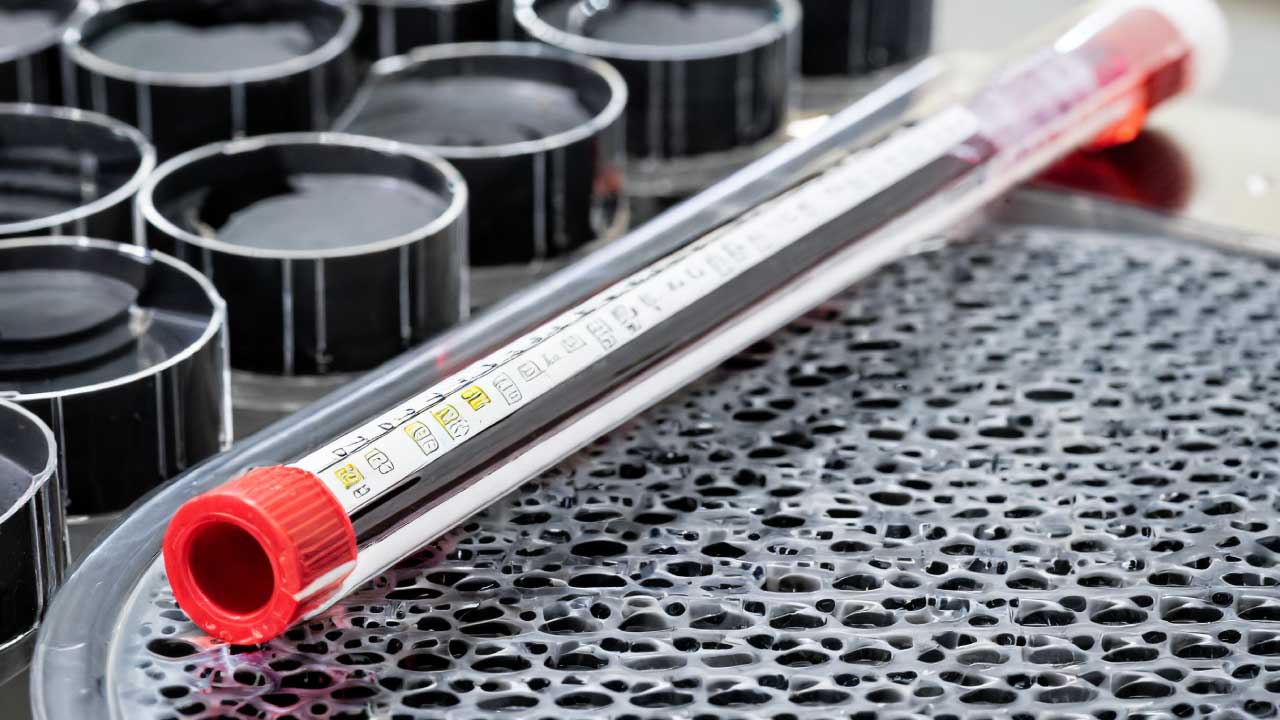
Procedure-at-a-Glance
This section provides a quick reference on ESR for lab technicians or students.
| Step | Action |
| Collection | Collect venous blood in a 3.8% sodium citrate tube (4:1 ratio) or EDTA. |
| Mixing | Gently invert the tube 8–10 times. |
| Setup | Fill the Westergren tube to the ‘0’ mark and place it in the rack. |
| Incubation | Leave the tube undisturbed at room temperature (20-25°C) for exactly 60 minutes. For some semi-automated or automated machines, readings can be taken at 30 minutes. |
| Reading | Measure the height of the clear plasma from the top (0) to the top of the red cell column. |
Introduction
The Erythrocyte Sedimentation Rate (ESR) test, also known as the sed rate or Westergren test, is a non-specific blood test that measures the rate at which red blood cells (RBCs) settle at the bottom of a tube. It is a simple and inexpensive test that can provide valuable information about the presence or absence of inflammation in the body.
The erythrocyte sedimentation rate (ESR) was first proposed by Fahraeus in 1918 and then described in detail by Westergren in 1920 which the tubes are named after. As this method poses a high biohazard risk due to the process of filling up the Westergren tube with blood, modern equipment using fully and semi-automated machines have been introduced.
People are often confused between ESR and C-Reactive Protein. While both are markers of inflammation, they behave very differently in the lab and in the body.
Erythrocyte Sedimentation Rate (ESR)
ESR does not measure a single protein. Instead, it measures how fast red blood cells (RBCs) fall. This is indirectly influenced by various “sticky” proteins (mainly fibrinogen) that cause RBCs to stack. Because it depends on the physical properties of RBCs, it can be “fooled” by blood disorders like anemia or sickle cell disease.
ESR is slow. It takes days to rise and can remain elevated for weeks after a patient has recovered. It is more like a “historical record” of recent inflammation.
Doctors often prefer CRP for diagnosing acute infections (like pneumonia or sepsis) because it shows up faster. However, ESR is still superior for monitoring specific chronic conditions such as Temporal Arteritis, Polymyalgia Rheumatica, and sometimes Systemic Lupus Erythematosus (SLE), where CRP might paradoxically remain normal despite a flare-up.
C-Reactive Protein (CRP)
CRP is a specific protein produced by the liver. When the body detects an injury or infection, it releases “messenger” chemicals (cytokines like IL-6) that tell the liver to produce CRP immediately. It is a direct measure of the inflammatory response.
CRP is fast. It rises within 4–6 hours of an injury, peaks at 36–48 hours, and drops quickly (half-life of 19 hours) once the inflammation is gone. It is like a “live feed” of the body’s status.
Comparison Table: ESR vs. CRP
| Feature | Erythrocyte Sedimentation Rate (ESR) | C-Reactive Protein (CRP) |
| What it measures | The rate at which RBCs settle in a tube (Indirect). | A specific protein produced by the liver (Direct). |
| Response Time | Slow (rises after 24–48 hours). | Fast (rises within 4–6 hours). |
| Recovery Time | Very slow (weeks to return to normal). | Fast (days to return to normal). |
| Sensitivity | Lower; can be normal in early inflammation. | Higher; detects even minor inflammation. |
| Specificity | Low; affected by age, sex, and RBC shape. | Higher; less affected by non-inflammatory factors. |
| Effect of Anemia | Significant: Falsely increases ESR. | No significant effect. |
| Effect of Age/Sex | Increases with age; higher in females. | Minimal effect. |
| Best Used For | Chronic inflammation, GCA, PMR, and SLE. | Acute infection, post-surgery, and sepsis. |
| Technical Errors | High risk (tube tilt, temperature, vibration). | Low risk (automated chemical assay). |
Principle of ESR
The erythrocyte sedimentation rate (ESR) measures the sedimentation rate or the length red blood cells fall in a vertical tube over a period of time. The principle of the erythrocyte sedimentation rate (ESR) test is based on the differences in densities of plasma proteins and RBCs. Since RBCs are denser than plasma proteins, they tend to settle at the bottom if kept at rest in a tube while the plasma collects above the RBC aggregate as supernatant.
However, in the presence of inflammation, the levels of plasma proteins, particularly fibrinogen, increase. Fibrinogen is a protein that plays a key role in blood clotting. When fibrinogen levels are high, it causes RBCs to aggregate together, forming rouleaux. Rouleaux are elongated stacks of RBCs that settle more quickly than individual RBCs.
The erythrocyte sedimentation rate (ESR) test is performed by filling a special Westergren tube with blood and then standing the tube upright. The time it takes for the RBCs to settle to the bottom of the tube is measured in millimeters per hour (mm/hr).
An elevated erythrocyte sedimentation rate (ESR) may indicate the presence of inflammation, infection, or other medical conditions such as autoimmune diseases, cancer, or pregnancy. However, it is important to note that the erythrocyte sedimentation rate (ESR) test is not specific and can be elevated for a variety of reasons. Therefore, it is important to interpret erythrocyte sedimentation rate (ESR) results in conjunction with other clinical findings.
The Three Stages of Sedimentation
The Initial Phase (Aggregation / Rouleaux Formation)
- Duration: Approximately 10 minutes.
- What happens: In this first stage, individual red blood cells (RBCs) begin to orient themselves and “stack” together like a pile of coins. This formation is called Rouleaux.
- The Science: RBCs naturally repel each other because they are negatively charged (this is called the Zeta Potential). However, in the presence of “acute phase reactants” like fibrinogen or globulins, this negative charge is neutralized. The more inflammation there is, the more these proteins “glue” the RBCs together.
- Key Note: This is the most critical stage. If Rouleaux formation is inhibited (by abnormal RBC shapes like sickle cells), the erythrocyte sedimentation rate (ESR) will be falsely low.
The Fast Phase (Decantation / Sedimentation)
- Duration: Approximately 40 minutes.
- What happens: Once the RBCs have formed heavy stacks (Rouleaux), they begin to fall rapidly through the plasma.
- The Science: This phase follows Stokes’ Law, which states that the velocity of a falling particle is proportional to its size. Because a stack of RBCs is much heavier and has less surface area relative to its mass than a single cell, it overcomes the resistance of the plasma and falls at a constant, maximum speed.
- Key Note: This is when most of the actual “distance” is covered in the Westergren tube. If the tube is tilted even slightly during this phase, the cells will slide down the side of the glass much faster, leading to a falsely elevated result.
The Final Phase (Packing)
- Duration: Approximately 10 minutes.
- What happens: As the RBC stacks reach the bottom of the tube, they begin to accumulate and “pack” together.
- The Science: The rate of sedimentation slows down significantly because the bottom of the tube is becoming crowded. The stacks of cells are no longer falling through clear plasma; they are landing on top of each other and compressing.
- Key Note: By the end of this stage, the separation between the clear plasma (top) and the red cell column (bottom) is distinct and ready to be read.
Why the “60-Minute” Rule Matters
Because these three stages take time to complete, the erythrocyte sedimentation rate (ESR) must be read at exactly 60 minutes.
- If we read it too early (during Stage 2), we miss the full sedimentation distance, leading to a falsely low result.
- If we read it too late, the packing phase may have progressed further than intended, though the change is usually less dramatic than an early reading.
Method differs slightly according to the manufacturer’s protocol.
Materials
- Sediplast system
- Blood collected in 3.8% sodium citrate anticoagulant or EDTA.
Protocol
- Fill the Sediplast tube with blood up to the graduation mark and close the tube properly with the pierceable stopper.
- Mix gently by inverting the tube several times.
- Insert the Westergren tube through the pierceable stopper until it hits the bottom of the tube. The blood will fill the Westergren tube through capillary action.
- Place the pierced tubes on the Sediplast system plate upright and record the number on the Westergren tube after 1 hour for the sedimentation rate count.
- Automated systems will read the tubes automatically and results can be seen on the reader panel.
Interpretation of Erythrocyte Sedimentation Rate (ESR)

ESR reference range
| Parameter | Male | Female | Unit |
| Child | 2 – 15 | 2 – 15 | mm/hr |
| 17 – 50 yr | 1 – 7 | 3 – 9 | mm/hr |
| 51- 60 yr | 2 – 10 | 5 – 15 | mm/hr |
False Positives (Falsely Elevated ESR)
In these cases, the RBCs fall faster than normal for reasons unrelated to an inflammatory immune response.
- Anemia (Low Hematocrit): This is the most common cause of a false positive. With fewer red cells in the plasma, there is less “crowding” and less upward resistance from the plasma. The cells have a clear path to the bottom and fall rapidly.
- Macrocytosis: Larger red blood cells (high MCV), such as those seen in Vitamin B12 or Folate deficiency, have a smaller surface-area-to-volume ratio. They act like larger “stones” and sink faster through the plasma.
- Pregnancy: Starting around the 10th to 12th week, fibrinogen levels naturally rise to prepare the body for the blood loss of childbirth. This increases the ESR significantly, often making the test unreliable during pregnancy.
- Renal Failure: Patients with end-stage renal disease often have very high ESRs (often >100 mm/hr). This is due to a combination of chronic anemia and changes in plasma proteins.
- Technical Error (Tilted Tube): This is a massive factor. If the Westergren tube is tilted even 3 degrees from vertical, the erythrocyte sedimentation rate (ESR) can increase by up to 30%. This happens because cells slide down the “low side” of the glass, avoiding the resistance of the plasma rising on the “high side.”
False Negatives (Falsely Low ESR)
These factors are particularly dangerous because they can “mask” a serious infection or autoimmune flare-up.
- Polycythemia: An abnormally high number of red blood cells causes “log-jamming.” The blood becomes so viscous and crowded that the cells physically cannot fall, even if inflammation is present.
- Abnormal RBC Shapes: This is a key hematology point. To fall fast, cells must form Rouleaux (stacks).
- Sickle Cells: The irregular “sickle” shape prevents cells from stacking.
- Spherocytes: Round cells (seen in Hereditary Spherocytosis) lack the flat surface needed to stack like coins.
- Acanthocytes: “Spiky” cells also interfere with stacking.
- Hyperviscosity (High Protein): While some protein increases erythrocyte sedimentation rate (ESR), extremely high protein levels (like in severe Waldenström’s Macroglobulinemia) make the plasma so thick that it acts like syrup, slowing the descent of the cells.
- Extreme Leukocytosis: A very high white blood cell count (as seen in Leukemia) can physically obstruct the path of the falling red cells.
- Technical Error (Old Sample): If blood sits for more than 2–4 hours before testing, the RBCs naturally lose their disc shape and become more spherical (echinocytes). As we learned with spherocytes, rounder cells do not stack well, leading to a falsely low result.
| Factor | Effect on ESR | Primary Reason |
| Anemia | Falsely High | Reduced “crowding” and friction. |
| Tilted Tube | Falsely High | Cells slide down the glass wall. |
| Pregnancy | High (Physiological) | Natural increase in fibrinogen. |
| Sickle Cell | Falsely Low | Cells cannot form Rouleaux (stacks). |
| Polycythemia | Falsely Low | High blood thickness/viscosity. |
| Old Sample | Falsely Low | RBCs become spherical and won’t stack. |
| Cold Temp | Falsely Low | Increases plasma viscosity. |
FAQs (Frequently Asked Questions)
Why is the ESR test called a “non-specific” test?
Erythrocyte sedimentation rate (ESR) is called non-specific because an elevated result only confirms the presence of inflammation in the body. It cannot pinpoint the exact location or the specific cause (infection, autoimmune disease, or cancer) without further testing.
Do I need to fast before an ESR blood test?
No, fasting is generally not required for an erythrocyte sedimentation rate (ESR) test. However, you should inform your doctor about any medications you are taking, as some drugs (like steroids or NSAIDs) can lower your result.
Why do women and older adults have higher “normal” ESR ranges?
Erythrocyte sedimentation rate (ESR) naturally increases with age. Women generally have higher rates due to lower hemoglobin levels (less resistance to falling) and hormonal variations during menstruation or pregnancy.
Can a normal ESR result mean I am healthy?
Not necessarily. A “normal” erythrocyte sedimentation rate (ESR) does not rule out the presence of a serious medical condition. Some inflammatory diseases or even certain cancers may not trigger a high erythrocyte sedimentation rate (ESR)in the early stages.
How does a tilted tube affect the result?
Even a 3-degree tilt in the Westergren tube can cause an error of up to 30%. A tilted tube allows cells to settle against the wall and slide down faster, leading to a falsely elevated result.
Glossary of Related Medical Terms
- Acute Phase Reactant: Proteins (like fibrinogen) that increase in the blood during inflammation.
- Anisocytosis: Variation in RBC size; can influence the rate of sedimentation.
- Fibrinogen: A plasma protein that acts as a “glue” to help RBCs form stacks.
- Hyperviscosity: Thickening of the blood which can paradoxically slow down the ESR.
- Non-specific Test: A test that indicates something is wrong (inflammation) but does not tell you exactly where or what the disease is.
- Rouleaux Formation: The stacking of red blood cells like a “pile of coins,” which causes them to settle faster.
- Stokes’ Law: The physical principle stating that larger particles (like RBC aggregates) fall faster through a fluid than smaller ones.
Disclaimer: This protocol is intended for informational purposes only and may need to be modified depending on the specific laboratory procedures and patient circumstances. Always consult with a qualified healthcare professional for guidance. See additional information.
References
- Bain BJ. A Practical Guide. 6th Edition (Wiley). 2022.
- Bain BJ, Bates I, Laffan MA. Dacie and Lewis Practical Haematology: Expert Consult: Online and Print 12th Edition (Elsevier). 2016.
- Jastinton A. LAB VALUES INTERPRETATION: The Indispensable Guide to Quickly Learn and Interpret The Laboratory Results.Find and Understand Everything That Impacts a Diagnosis of Disease. 2021.