Key Takeaways
Pure red cell aplasia (PRCA) is a rare bone marrow disorder in which the marrow selectively stops making red blood cells, while white cells and platelets stay normal. PRCA differs from aplastic anemia because only one cell line, the erythroid line, is affected. This narrows the differential and changes the workup.
- Causes ▾: Causes fall into congenital and acquired forms. The congenital form is Diamond-Blackfan anemia. Acquired PRCA can be primary (autoimmune) or secondary to thymoma, parvovirus B19 infection, drugs, large granular lymphocyte leukemia, or other autoimmune diseases.
- Symptoms ▾: The symptoms reflect symptoms of anemia due to the deficiency in red blood cells like fatigue, pallor, shortness of breath and tachycardia.
- Diagnosis ▾: Diagnosis rests on severe reticulocytopenia (often under 1%) with a bone marrow biopsy showing near-absent erythroid precursors and preserved white cell and platelet lineages.
- Treatment ▾: Treatment is cause-specific. Parvovirus B19-related PRCA responds to intravenous immunoglobulin (IVIG), thymoma-associated PRCA often improves after thymectomy, and idiopathic or autoimmune PRCA is treated with cyclosporine, which has the highest first-line response rate of any agent studied. Most acquired PRCA is treatable, though relapse is common and some patients need long-term immunosuppression or repeated courses of therapy.
*Click ▾ for more information
What is pure red cell aplasia?
Pure red cell aplasia (PRCA) is a rare condition in which the bone marrow almost completely stops producing red blood cells [2,4]. The name tells you exactly what happens: the failure is "pure," meaning it targets red cells only. White blood cells and platelets are made normally.
This is the key feature that separates PRCA from aplastic anemia. In aplastic anemia, all three cell lines collapse together because the injury hits the hematopoietic stem cell itself. In PRCA, the defect sits further down the production line, at the erythroid precursor stage, so only red cell output fails [4].
The result is a severe, normocytic, normochromic anemia. Because red cells live about 120 days and the marrow has essentially stopped replacing them, hemoglobin falls steadily, roughly 0.1 g/dL per day, until the patient becomes transfusion-dependent [4].
How is PRCA classified?
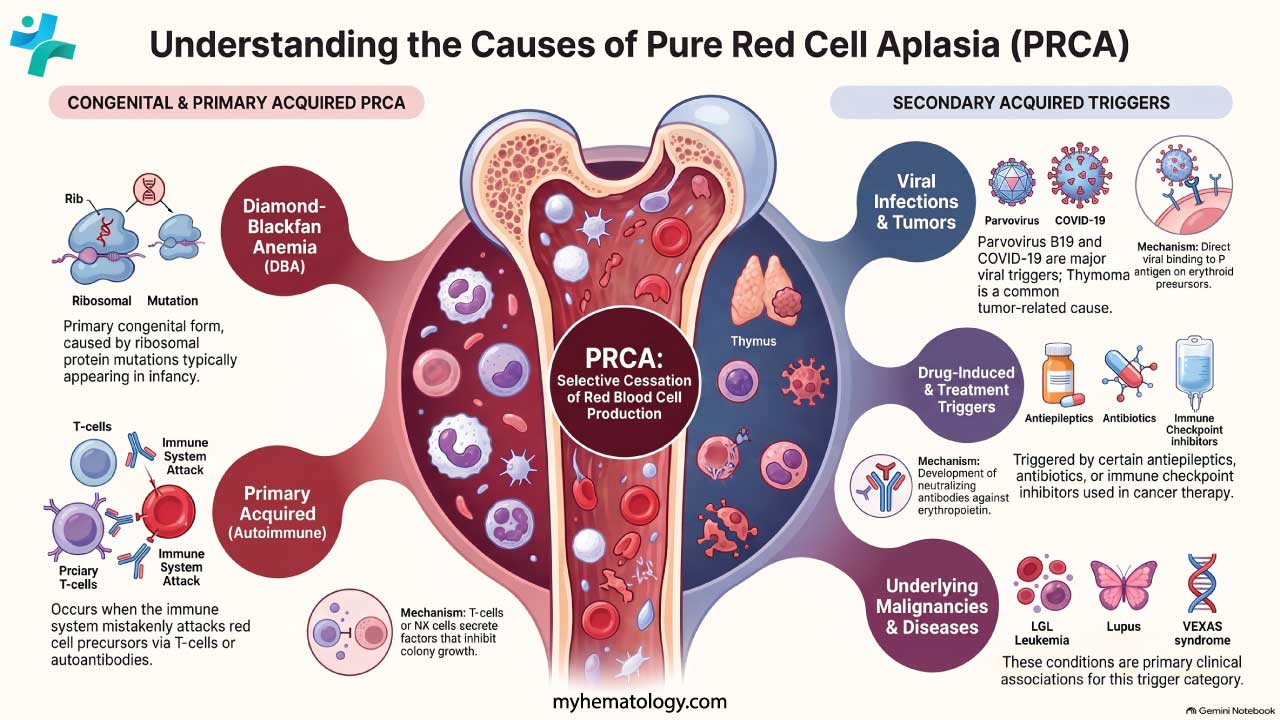
PRCA is split into two broad categories, and getting this distinction right shapes the entire workup.
Congenital PRCA: Diamond-Blackfan anemia
This inherited form usually appears in infancy or early childhood. It is caused by mutations affecting ribosomal proteins and often comes with physical features such as short stature, thumb abnormalities, and craniofacial differences. It is managed differently from adult-onset PRCA and often requires long-term corticosteroids, chronic transfusion support, or stem cell transplant [7].
Acquired PRCA
Acquired PRCA is further split into primary and secondary forms [2,4].
Primary acquired PRCA is autoimmune. The immune system attacks red cell precursors directly, either through autoreactive T cells, natural killer cells, or antibodies against erythroblasts or erythropoietin itself [5].
Secondary acquired PRCA occurs alongside, or because of, another condition. Recognized causes include:
- Thymoma — a tumor of the thymus gland, present in a meaningful minority of adult PRCA cases and important to rule out at diagnosis with chest imaging [1,4]
- Parvovirus B19 infection — this virus has a direct affinity for erythroid precursors and can shut down red cell production completely, especially in patients who are immunocompromised and cannot clear the virus on their own [6]
- Large granular lymphocyte (LGL) leukemia — a clonal lymphoproliferative disorder frequently associated with PRCA [5]
- Autoimmune diseases, particularly systemic lupus erythematosus
- Drugs, including some antiepileptics, antibiotics such as rifampicin, and erythropoiesis-stimulating agents (ESAs) that can trigger antibodies against erythropoietin itself [3]
- Pregnancy, a rare but recognized trigger, with spontaneous remission sometimes following delivery [4]
- Lymphoma and other hematologic malignancies
- ABO-mismatched stem cell or organ transplant, where PRCA can develop from antibody-mediated destruction of donor red cell precursors
- VEXAS syndrome — a newly discovered autoinflammatory disorder caused by somatic UBA1 mutations, primarily affecting older men and frequently presenting with systemic inflammation and bone marrow failure, including PRCA [8].
- COVID-19 infection — recognized as a novel viral trigger for acquired secondary PRCA, driven by post-viral immune dysregulation [9].
- Immune checkpoint inhibitors (ICIs) — as cancer immunotherapy expands, drugs like nivolumab and pembrolizumab are documented triggers for severe, immune-mediated PRCA, requiring careful differentiation from bone marrow metastasis [10].
What causes bone marrow failure in PRCA?
The underlying defect in most acquired PRCA is immune-mediated destruction of erythroid precursors, not the stem cell itself [3,5]. This distinction matters because it explains why white cells and platelets are spared: the immune attack targets cells that are already committed to becoming red cells, one step past the pluripotent stem cell that both aplastic anemia and PRCA can affect.
Three overlapping mechanisms are described [5]:
- Autoreactive T cells that secrete factors selectively inhibiting erythroid colony growth in the bone marrow
- Autoantibodies directed against erythroblasts or, in ESA-associated PRCA, against erythropoietin itself
- Natural killer (NK) cells that directly lyse erythroid precursor cells
Parvovirus B19 works through a separate, well-defined mechanism. The virus binds to the P antigen receptor on erythroid precursors and blocks their maturation directly, without needing an autoimmune step at all [6]. This is why parvovirus-related PRCA is treated completely differently, with antiviral immunoglobulin rather than immunosuppression.
Signs and symptoms
Because only the red cell line is affected, the symptom picture in PRCA is narrower than in aplastic anemia. There is no increased infection risk and no abnormal bleeding, since white cells and platelets remain normal.
Symptoms come entirely from anemia:
- Fatigue and weakness, often the presenting complaint
- Pallor, visible in the skin and inside the eyelids
- Shortness of breath, especially on exertion, and in severe cases even at rest
- Rapid heart rate (tachycardia), as the heart compensates for reduced oxygen delivery
Onset can be gradual, particularly in autoimmune PRCA, or abrupt, particularly with parvovirus B19 infection, where hemoglobin can fall sharply within one to two weeks [1]. A sudden weekly hemoglobin drop of about 1 g/dL, or a new weekly transfusion requirement, should raise suspicion for PRCA [1].
How is PRCA diagnosed?
Diagnosis rests on three findings together: severe anemia, severe reticulocytopenia, and a bone marrow biopsy showing selective erythroid loss [4].
Full blood count: normocytic, normochromic anemia. White cell and platelet counts are typically within the normal range, which is the single most useful clue pointing away from aplastic anemia and toward PRCA [4].
Reticulocyte count: markedly reduced, usually under 1% (an absolute count under roughly 10,000/µL). This confirms the marrow is not compensating for the anemia at all [4].
Bone marrow aspirate and biopsy: near-absence of erythroid precursors, while granulocyte and megakaryocyte lineages look normal. In parvovirus B19 infection, giant pronormoblasts, unusually large, abnormal red cell precursors, are a characteristic finding [6].
Cause-finding investigations, ordered once PRCA is confirmed:
- Quantitative Parvovirus B19 DNA PCR to identify active infection. PCR is heavily preferred over serology, as IgM and IgG testing are notoriously unreliable in the immunocompromised patients most at risk for parvovirus-induced PRCA [11]
- Next-Generation Sequencing (NGS) panels to identify somatic UBA1 mutations for VEXAS syndrome, confirm LGL leukemia via STAT3 mutations, rule out underlying myelodysplastic syndromes, or detect late-onset Diamond-Blackfan anemia in adults [8]
- Chest CT to look for thymoma, even in the absence of another obvious cause [1]
- Flow cytometry and T-cell clonality studies to look for LGL leukemia
- Autoimmune serology (ANA, and related tests) if lupus or another autoimmune disease is suspected
- Medication review, checking for any drug linked to PRCA, including recent ESA use
- BFU-E colony assay, where available, which helps separate autoimmune PRCA from underlying myelodysplastic syndrome presenting as erythroid failure [4]
PRCA versus aplastic anemia: what's the difference?
| Feature | PRCA | Aplastic Anemia |
|---|---|---|
| Cell lines affected | Red cells only | Red cells, white cells, and platelets |
| White cell / platelet count | Normal | Low |
| Bone marrow target | Erythroid precursors | Hematopoietic stem cells |
| Infection risk | Not increased | Increased (neutropenia) |
| Bleeding risk | Not increased | Increased (thrombocytopenia) |
| Typical triggers | Thymoma, parvovirus B19, LGL leukemia, autoimmune disease | Idiopathic autoimmune, drugs, radiation, inherited syndromes |
Treatment and management of PRCA
Treatment in PRCA is built around one central principle: treat the cause first [1]. This is different from aplastic anemia, where immunosuppression is the default starting point for most patients.
Supportive care
- Red cell transfusions to manage symptomatic anemia while the underlying cause is being treated
- Iron monitoring, since chronically transfused patients are at risk of iron overload over time, similar to other chronic transfusion-dependent anemias
Cause-directed treatment
Parvovirus B19-related PRCA: Treated with intravenous immunoglobulin (IVIG). This is considered an effective, fast-acting, specific treatment, particularly in immunocompromised patients who cannot clear the virus on their own [1,6]. A reticulocyte "crisis," a sudden rise in reticulocyte count, often signals recovery is underway.
Thymoma-associated PRCA: Thymectomy (surgical removal of the thymus) is the standard approach. Most patients improve, though not all achieve a full cure, and some still require ongoing immunosuppression afterward [1].
Drug-induced PRCA: Stopping the causative medication is usually sufficient. For Erythropoiesis-Stimulating Agent (ESA)-associated PRCA, switching to a Hypoxia-Inducible Factor Prolyl Hydroxylase (HIF-PH) inhibitor, such as roxadustat, has proven highly effective at bypassing neutralizing anti-EPO antibodies and restoring red cell production [12].
Primary or other autoimmune PRCA: Immunosuppression is the mainstay. Corticosteroids are typically used first, often together with cyclosporine which has a first-line response rate of roughly 76% [1]. For refractory cases, rituximab (an anti-CD20 monoclonal antibody) is increasingly favored. Additionally, the thrombopoietin receptor agonist (TPO-RA) eltrombopag has demonstrated significant off-label efficacy in restoring erythropoiesis for treatment-resistant patients [13].
LGL leukemia-associated PRCA: Treated with immunosuppression directed at the underlying clonal T-cell disorder, often overlapping with the agents used above [5].
Congenital PRCA (Diamond-Blackfan anemia): Managed historically with corticosteroids, chronic transfusion support, or hematopoietic stem cell transplant. Recently, L-leucine (an essential amino acid that promotes mRNA translation) has demonstrated clinical efficacy as a targeted therapy to improve anemia and linear growth in steroid-refractory patients [14].
Prognosis
Prognosis depends heavily on the underlying cause. Drug-induced and parvovirus-related PRCA are usually reversible within a few months once treated appropriately [1]. Idiopathic PRCA tends to follow a more chronic course, with patients often needing intermittent or long-term immunosuppression; average life expectancy in idiopathic PRCA is measured in decades rather than years [4]. Congenital PRCA (Diamond-Blackfan anemia) has a more variable course dependent on transfusion burden and treatment response. Secondary PRCA generally tracks the course of the underlying disease, whether that is a thymoma, LGL leukemia, or an autoimmune disorder [7].
Frequently Asked Questions (FAQs)
What is pure red cell aplasia (PRCA) in simple terms?
PRCA is a rare bone marrow disorder in which the marrow stops making red blood cells while continuing to make normal numbers of white blood cells and platelets. It causes severe anemia with symptoms like fatigue, pale skin, and shortness of breath, but it does not raise infection or bleeding risk.
How is PRCA different from aplastic anemia?
Aplastic anemia affects all three blood cell lines because it damages the hematopoietic stem cell. PRCA affects only red blood cells because the defect sits one step further along the production line, in the erythroid precursor cells. A normal white cell and platelet count alongside severe anemia is the main clue pointing toward PRCA.
What causes PRCA?
PRCA can be congenital (Diamond-Blackfan anemia) or acquired. Acquired PRCA is either primary, meaning autoimmune with no identifiable trigger, or secondary to a known cause such as thymoma, parvovirus B19 infection, large granular lymphocyte leukemia, certain medications, or autoimmune diseases like lupus.
How is PRCA treated?
Treatment depends entirely on the cause. Parvovirus B19-related PRCA is treated with intravenous immunoglobulin. Thymoma-associated PRCA is treated with thymectomy. Drug-induced PRCA usually resolves once the causative medication is stopped. Idiopathic and other autoimmune forms are treated with immunosuppression, most often cyclosporine with or without corticosteroids.
Can PRCA be cured?
Many cases of secondary PRCA resolve once the underlying cause is treated, for example after antiviral immunoglobulin for parvovirus B19 or thymectomy for thymoma. Idiopathic PRCA tends to be more chronic and often needs long-term or repeated immunosuppression, though most patients respond to treatment and can achieve durable control of their anemia.
Is PRCA hereditary?
The congenital form, Diamond-Blackfan anemia, is hereditary and caused by mutations affecting ribosomal proteins. It usually presents in infancy or early childhood, sometimes with physical abnormalities such as thumb defects or short stature. Acquired PRCA, which is far more common in adults, is not inherited.
Glossary of Related Medical Terms
- Erythroid precursor: An immature cell in the bone marrow that is developing into a mature red blood cell.
- Erythropoiesis: The process of making red blood cells.
- Giant pronormoblast: An abnormally large, immature red cell precursor seen on bone marrow biopsy, characteristic of parvovirus B19 infection.
- Large granular lymphocyte (LGL) leukemia: A slow-growing clonal disorder of large granular lymphocytes, frequently linked to PRCA.
- Reticulocyte: A newly made, immature red blood cell. Reticulocyte count reflects how actively the marrow is producing red cells.
- Reticulocytopenia: An abnormally low reticulocyte count, the hallmark laboratory finding in PRCA.
- Thymoma: A tumor arising from the thymus gland, an organ involved in T-cell development, linked to several autoimmune conditions including PRCA.
- Thymectomy: Surgical removal of the thymus gland, used to treat thymoma-associated PRCA.
Disclaimer: This article is intended for educational and informational purposes only. It is not intended to be a substitute for informed professional medical advice, diagnosis, or treatment. While the information presented here is derived from credible medical sources and is believed to be accurate and up-to-date, it is not guaranteed to be complete or error-free. See additional information.
References
- Lobbes, H., Lega, J. C., Le Guenno, G., Ruivard, M., & Mainbourg, S. (2023). Treatment strategy for acquired pure red cell aplasia: a systematic review and meta-analysis. Blood advances, 7(21), 6451–6465. https://doi.org/10.1182/bloodadvances.2023010587
- Sawada, K., Fujishima, N., & Hirokawa, M. (2008). Acquired pure red cell aplasia: updated review of treatment. British journal of haematology, 142(4), 505–514. https://doi.org/10.1111/j.1365-2141.2008.07216.x
- Means, R. T. (2016). Pure red cell aplasia. Blood, 128(21), 2504–2509. https://doi.org/10.1182/blood-2016-05-717140
- Fisch, P., Handgretinger, R., & Schaefer, H. E. (2000). Pure red cell aplasia. British journal of haematology, 111(4), 1010–1022. https://doi.org/10.1046/j.1365-2141.2000.02429.x
- Vlachaki, E., Diamantidis, M. D., Klonizakis, P., Haralambidou-Vranitsa, S., Ioannidou-Papagiannaki, E., & Klonizakis, I. (2012). Pure red cell aplasia and lymphoproliferative disorders: an infrequent association. TheScientificWorldJournal, 2012, 475313. https://doi.org/10.1100/2012/475313
- Crabol, Y., Terrier, B., Rozenberg, F., Pestre, V., Legendre, C., Hermine, O., Montagnier-Petrissans, C., Guillevin, L., Mouthon, L., & Groupe d'experts de l'Assistance Publique-Hôpitaux de Paris (2013). Intravenous immunoglobulin therapy for pure red cell aplasia related to human parvovirus b19 infection: a retrospective study of 10 patients and review of the literature. Clinical infectious diseases : an official publication of the Infectious Diseases Society of America, 56(7), 968–977. https://doi.org/10.1093/cid/cis1046
- Narla, A., Vlachos, A., & Nathan, D. G. (2011). Diamond Blackfan anemia treatment: past, present, and future. Seminars in hematology, 48(2), 117–123. https://doi.org/10.1053/j.seminhematol.2011.01.004
- Beck, D. B., Ferrada, M. A., Sikora, K. A., Ombrello, A. K., Collins, J. C., Pei, W., Balanda, N., Ross, D. L., Ospina Cardona, D., Wu, Z., Patel, B., Manthiram, K., Groarke, E. M., Gutierrez-Rodrigues, F., Hoffmann, P., Rosenzweig, S., Nakabo, S., Dillon, L. W., Hourigan, C. S., Tsai, W. L., … Grayson, P. C. (2020). Somatic Mutations in UBA1 and Severe Adult-Onset Autoinflammatory Disease. The New England journal of medicine, 383(27), 2628–2638. https://doi.org/10.1056/NEJMoa2026834
- Yamazaki, S., Naito, E., Sekiya, R., Yogi, S., Komiyama, K., Miyakawa, Y., & Nagata, M. (2022). Pure red cell aplasia accompanied by COVID-19 successfully treated using cyclosporine. Journal of infection and chemotherapy : official journal of the Japan Society of Chemotherapy, 28(2), 304–307. https://doi.org/10.1016/j.jiac.2021.10.018
- Bisiou, S., Lobbes, H., Palassin, P., Allouchery, M., Comont, T., & Rivet, V. (2026). Immune checkpoint inhibitor-induced pure red cell aplasia: a nationwide retrospective case series and literature review. Annals of hematology, 105(2), 38. https://doi.org/10.1007/s00277-026-06748-0
- Invernizzi R. (2022). Images from the Haematologica Atlas of Hematologic Cytology: parvovirus-induced pure red cell aplasia. Haematologica, 107(7), 1493. https://doi.org/10.3324/haematol.2022.281331
- Wu, R., & Peng, Y. (2021). Roxadustat on anti-erythropoietin antibody-related pure red cell aplasia in the patient with end-stage renal disease. Seminars in dialysis, 34(4), 319–322. https://doi.org/10.1111/sdi.12991
- Liu, X., Cheng, L., He, Y., Zhang, R., Lu, R., Zhang, J., Hong, M., He, G., & Li, J. (2021). Eltrombopag restores erythropoiesis in refractory adult acquired pure red cell aplasia. International journal of hematology, 114(1), 124–128. https://doi.org/10.1007/s12185-021-03100-2
- Vlachos, A., Atsidaftos, E., Lababidi, M. L., Muir, E., Rogers, Z. R., Alhushki, W., Bernstein, J., Glader, B., Gruner, B., Hartung, H., Knoll, C., Loew, T., Nalepa, G., Narla, A., Panigrahi, A. R., Sieff, C. A., Walkovich, K., Farrar, J. E., & Lipton, J. M. (2020). L-leucine improves anemia and growth in patients with transfusion-dependent Diamond-Blackfan anemia: Results from a multicenter pilot phase I/II study from the Diamond-Blackfan Anemia Registry. Pediatric blood & cancer, 67(12), e28748. https://doi.org/10.1002/pbc.28748